Bachelor of Arts (Honours) in Environmental Governance
at University of Guelph Canada

Overview
Understand the geographical, political and economic factors that shape environmental issues. Learn how to identify and manage these issues across sectors. Address environmental challenges through creative partnerships between governments, communities and businesses. Train to be an environmental professional at the leading edge of sustainability.
30
Application Processing Days
Under Graduate
Program Level
Fact & Figures
Full Time On Campus
Study Mode
48
Duration
University of Guelph
Location
Bachelor of Arts (Honours) in Environmental Governance Assistant Fee
$30232
Tuition Fee
$11000
Average Cost of Living
$90
Application Fee
Bachelor of Arts (Honours) in Environmental Governance Admissions Requirements
- Minimum Level of Education Required: To be accepted into this program, applicants must have Grade 12 / High School Diploma.

Get superfast admissions at top Bachelor of Arts (Honours) in Environmental Governance institutes in 2024
Benefits of choosing

➤Admission’s guaranteed at Top institutes across the world.
➤Enjoy exclusive application fee waiver’s with Edmissions.
➤Unlimited FREE Counselling sessions with Edmission’s
Experts
➤Get Tips from industry veterans to crack the IELTS exam in 1
week.
➤Assistance with scholarships, loans, forex, student accommodation and visa guidance.
Work Permit Canada
Students who wish to work in Canada require a work permit to do so. A student in Canada can work part-time during the course of his studies and full-time during holidays and semester breaks and post the completion of their course/program.
Rules for getting a part-time work visa in Canada
You can also work part-time on campus at your university.
Work Permit
Duration
Your part-time work permit will be valid for as long as you have a valid study permit.
Working Hours
20 Hours/Week
As a full-time student, you can work for a maximum of 20 hours a week. However, you can work full- time during holidays and breaks.
Document Required to Work in Canada
List
To apply for a work permit, you will need a study permit that mentions that you are allowed to work part-time on campus.
Social Insurance Number
Study Permit
You will need a Social Insurance Number (SIN) to Service Canada. if you wish to work in Canada during the course of your studies. To apply for the same, you need a valid study permit, and you should be a full- time student at a recognized university.

You can work part-time off-campus if you are studying in the Quebec province.
Duration of Work Permit Canada
Your part-time work permit will be valid for as long as you have a valid study permit.
Work Hours Canada
As a full-time student, you can work for a maximum of 20 hours a week. However, you can work full- time during holidays and breaks.
Document Required to Work in Canada
To apply for a work permit, you will need a study permit that mentions that you are allowed to work part-time on campus.
Social Insurance Number
You will need a Social Insurance Number (SIN) to Service Canada if you wish to work in Canada during the course of your studies. To apply for the same, you need a valid study permit, and you should be a full- time student at a recognized university.
Working after completing your course
In Canada, you will need a work permit to get a full-time job in Canada after finishing your studies. You chose a work permit like the Post-Graduation Work Permit (PGWP) if you wish to stay back in Canada and work full-time.
Visit Government of Canada Website for more detail
Post-Graduation Work Permit (PGWP)
The Post- Graduation Work Permit (PGWP) allows you to work for three years in Canada if you have completed a two years degree or more.

Application
how can i apply
You can either apply online or download the form and mail the application along with the required documents. Pay your fee and then wait for the decision to come.
Application Documents Required
List
To apply for the work visa, you need a degree from a recognized and accredited Canadian University along with an intention to stay and work in Canada only temporarily.
When to Apply?
One can apply for the full-time work permit in the first three months post the completion of their course during which the study permit is still valid.
How long does it take?
90 days
You will have to wait for 90 days for the decision on your work permit.
Duration
3 Years
The work permit is valid for 3 years if you have completed a two years degree program or more.
Fees
CAD 255
The fee for the work permit is CAD 255 plus the holder fee and the work permit processing fee.
Monthly Wages
CAD 1,600
An applicant is guaranteed a minimum salary of CAD 1,600 per month while working in Canada. This amount though varies on the job and the province you are working in.
Work Hours Canada
No Limit
There is no maximum limit, and you can work for as many hours as you want on the full-time work permit.
Required Documents
List
To apply for the work visa, you will need the following documents:
- Forms: IMM 5710, IMM 5476 and IMM 5475;
- Graduation Proof
- Proof of payment of work permit fees
- Copies of your travel and identification documents, passport pages and current immigration document.
Till a decision is made on your work visa, you can continue to work full time. All you need to have is your completed degree, should have applied for the permit before the expiry of your study permit and you should be allowed to work off-campus.
Information
Disclaimer
The information provided about the work permit is true and complete to the best of our knowledge. All recommendations are made without any guarantee on the part of the author or the publisher. The author and the publisher, therefore, disclaim any liability in connection to and with the use of this information.
Detailed Program and Facts
30
Application Processing Days
Full Time On Campus
Program Intensity
Under Graduate
Program Level
48
Duration
Study Visa
Student Visa For Canada
Any student who wishes to study in Canada requires a student visa. Some of the essential information for the application process is given below.
When Should I Apply?
4 to 6 months
Ideally, one should apply for the study permit at least 4 to 6 months before the commencement of your course/program.
Bank Account
No Need!
There is no need for a blocked bank account to apply for a student visa to Canada.
Duration of visa
Course Duration + 3 Months
The student visa is valid for the entire period of your course plus three months.
Time to Wait for Visa
35 Days
It takes time. It might take up to 35 days post your interview for the application process to complete and for you to finally receive your visa.
Appointment
Required
It varies from applicant to applicant, but one may have to take part in one or two visa appointments, namely a medical examination and a visa interview.
How you can apply
Application Process
An applicant can either apply online or offline by visiting a visa application centre and submitting their documents. After the analysis of your application, you might be called for an interview.
Fee
Visa Fee
The visa application fee for Canada is CAD 150.
Minimum Funds
833 CAD, 917 CAD
You require a minimum monthly amount to be deposited into your account to prove that you can sustain yourself while studying in Canada. If you are studying in Quebec, you need to have a monthly minimum of CAD 917, and if you are studying in a province except for Quebec, you need to have a minimum of CAD 833 per month.
Any other expenses
Required
You will have to pay a medical examination fee and a visa application service fee to the tune of CAD 15 if you visit a visa application centre to apply for your visa.
Medical Examination
Required
One has to undergo a series of medical examinations to be deemed fit for a student visa of Canada. The tests mostly include blood and urine tests, chest x-rays and other organ checkups.
Language Skills
Not Required
one doesn’t need to prove their language skills in applying for a Canadian Visa.
Disclaimer: The information provided about the work permit is true and complete to the best of our knowledge. All recommendations are made without any guarantee on the part of the author or the publisher. The author and the publisher, therefore, disclaim any liability in connection to and with the use of this information.
Other Courses by University of Guelph,Canada
Natural Sciences & Mathematics
Bachelor of Science (Honours) in Physical Science
Create your own curriculum and explore Physical Science. Focus on chemistry, computing and information science, mathematics, physics or statistics. Build the necessary background for further studies in a specific area of your choice or continue in the major of Physical Science. Choose a minor in subjects like biotechnology, geographic information systems, psychology or business to meet your career goals or pursue professional schools.
48 month
Duration
$ 30238
Tuition
Business & Management
Bachelor of Commerce in Management Economics and Finance
The Management Economics and Finance major is designed to offer students an appreciation of business and economic problems particularly in the area of finance.
The major provides a suitable education for a career in the business world or in the public service. It also constitutes a useful preparation for more advanced studies, including graduate studies in Economics, Finance, Business Administration, Accounting, Industrial Relations, Law, and Public Policy.
48 month
Duration
$ 35638
Tuition
Arts & Humanities
Bachelor of Arts General
Choose between 15 areas of concentration in the three years BA General degree. This flexible, multidisciplinary three-year degree involves a generalized study of a broad range of subjects and allows you to tailor your studies to your interests and career plans.
Areas of concentration are:
- Anthropology;
- English;
- French studies;
- Geography;
- History;
- International development studies;
- Mathematics;
- Music;
- Philosophy;
- Political science;
- Psychology;
- Sociology;
- Spanish and Hispanic studies;
- Statistics;
- Theatre studies.
36 month
Duration
$ 30236
Tuition
International Development Studies (IDS) is an interdisciplinary undergraduate program that explores the nature and impacts of economic and social development in Canada and around the world. The IDS program will equip you with the theoretical understanding and analytical and practical skills needed to bring about positive and inclusive change in the world. As an IDS student, you will gain firsthand knowledge and real world experience for tackling complex development challenges, such as poverty, food insecurity and global climate change and to promote social justice as citizens in careers across the public and private sectors and in civil society organizations.
In the IDS major, you will complete one of four areas of emphasis: Agriculture and Food Security, Environment and Sustainable Development, Development in the Canadian Context, Development in Fragile Contexts. In so doing, you will have the opportunity to specialize in an area of international development that is of particular interest to you.
WHY CO-OP?
As a co-op student, you will gain firsthand work experience, build professional networks, and develop essential interpersonal skills that are absolutely essential for pursuing a career in international development. You will also get paid while earning your university degree. Guelph’s co-op program is unique due to the exceptional level of support provided, including a co-op preparatory course, and a personal connection with Co-op Coordinators to assist you during the employment process, and access to senior student mentors.
48 month
Duration
$ 30232
Tuition
Natural Sciences & Mathematics
Bachelor of Science in Molecular Biology and Genetics (Co-op)
Molecular Biology and Genetics covers genomes and the genetics of microorganisms, plants and animals, and the structure and function of cells.
The variety of courses offered in the program covers a broad range of topics such as molecular biology, genetics, cell biology, developmental biology and agricultural genetics. Undergraduate laboratories will provide you with the practical skills and knowledge needed to perform basic procedures commonly used in the field of molecular biology and genetics. Additionally, you will develop the ability to analyze and interpret experimental results obtained in a laboratory setting. In your upper years, you will also have the opportunity to access some of the University of Guelph’s outstanding research labs and facilities.
Learning Outcomes
You can expect to learn how to:
- Explain the molecular mechanisms of genetic inheritance that drive the evolution of populations.
- Describe the synthesis and structure of macromolecules and their roles in cellular processes.
- Explain how gene regulation networks and signal transduction cascades enable development and adaptation to the environment.
- Design and implement experimental procedures using relevant techniques in gene analysis and manipulation and genetic engineering in model systems.
Co-Op Options
Molecular Biology and Genetics co-op is a five-year program, which includes four work terms. Below is an example of how the academic and work sequence will look for a Microbiology major.
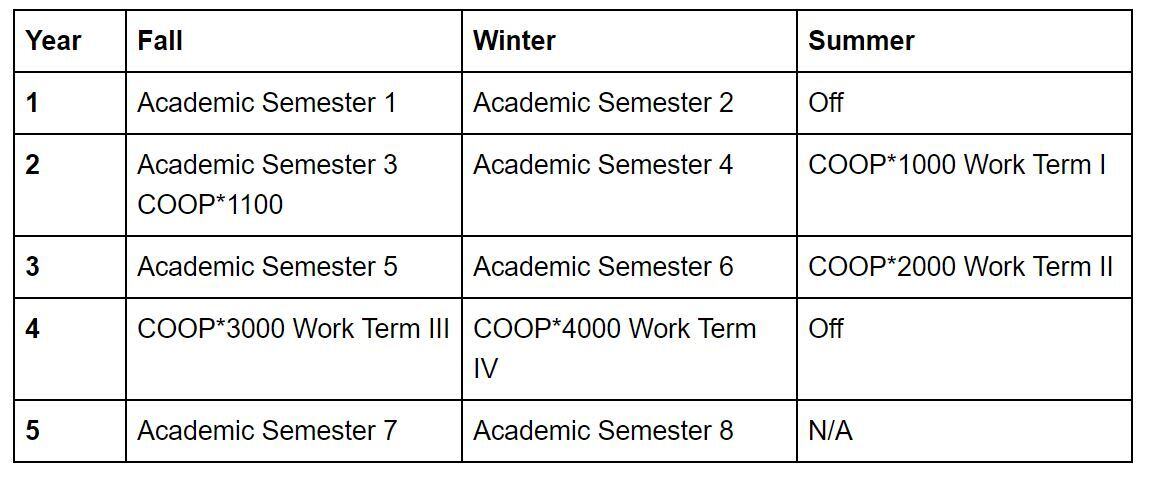
*Please note this sequence may change. The current undergraduate calendar will house the most accurate sequence that students must follow.
Students in this co-op major complete a course, COOP*1100, in the fall semester of second year. This course helps students prepare for their work term by developing professional attitudes and skills for the workplace. This course also provides students with a toolkit of resume and cover letter writing as well as interview skills, which helps students to apply, interview and secure their work term positions.
60 month
Duration
$ 30237
Tuition
Natural Sciences & Mathematics
Bachelor of Science in Biological and Pharmaceutical Chemistry
Biological and Pharmaceutical Chemistry is a fascinating interdisciplinary area of growth. Located at the interface of chemistry and biology, this discipline brings opportunities to combine the powers of chemistry with exciting developments in biology.
This major combines the University of Guelph’s strength in the biological sciences whilst maintaining a strong chemistry-oriented understanding of the molecular basis for biological structure and function. At the University of Guelph, Learning Centres are staffed by teaching assistants to support students in addition to classes sizes in modern, well-equipped laboratories. U of G is well known for the breadth of its biological science programs, and students can avail themselves of the opportunity to take biology courses in a number of areas as part of the Biological and Pharmaceutical Chemistry Program. All students graduate with exceptional laboratory experience in analytical instrumental laboratories and exploring molecular structures with the undergraduate nuclear magnetic resonance (NMR) spectrometer.
Students take an integrated MATH and PHYS course in first year along with the chemistry and biology taken by other science students. Second through fourth year, students take courses that focus on organic synthesis and analytical tools of relevance to both chemistry and biology. The major provides an option in third year to select hands-on training in pharmaceutical analysis, pharmacology and applied toxicology biopharmaceuticals through Seneca College.
Learning Outcomes
You can expect to learn how to:
- Gather, critically assess, and utilize primary scientific literature to research a topic
- Evaluate the limitations of and troubleshoot experimental approaches.
- Demonstrate advanced, contemporary and relevant knowledge in chemistry
- Demonstrate knowledge of the environmental, health implications of scientific discovery and technological innovation.
- Work safely and effectively in the laboratory to generate reproducible and reliable results
- Conduct research effectively and reliably with relevant computational tools and modern chemical instrumentation
48 month
Duration
$ 30238
Tuition
Health Sciences, Nursing and Emergency Services
Bachelor of One Health
College of Biological Science, Department of Integrative Biology, College of Social and Applied Human Sciences Department of Sociology and Anthropology, Ontario Veterinary College and Ontario Agricultural College, School of Environmental Sciences
The One Health degree offers students the opportunity to explore animal, environmental and human health from both the scientific and socio-cultural perspectives. One Health is an approach to research and problem-solving that brings together different knowledge systems and perspectives in order to find solutions that ensure people, animals, and our environment stay healthy.
Students in the One Health degree are required to complete a One Health core, comprising required courses and restricted electives. Students will also be required to declare one of four areas of emphasis by the end of the first year of their program. As part of the OH core, students will complete a set of preparation courses, in year 1 and 2, for their preferred Area of Emphasis (hereafter referred to as sub-core)
48 month
Duration
$ 30290
Tuition
Engineering & Technology
Bachelor of Engineering in Engineering System and Computing (Co-op)
Engineering Systems and Computing is a multi-disciplinary field that combines the base fundamentals of general engineering with the strength of computer hardware and software knowledge.
Engineering Systems and Computing is the only program of its kind in Canada that focuses on designing integrated computer based engineering systems. It includes a mix of courses that cover software development, computer hardware design, mechanics and energy transfer, signal processing and optimization control.
You will understand the strengths and limitations of hardware, software and their controls in order to develop efficient and reliable systems in a variety of industrial and commercial applications. This unique mix will empower you to tackle the design of modern systems that requires multi-disciplinary skills and knowledge.
Co-op
The Co-op program in Engineering Systems and Computing is a five year program, including five work terms. Students must complete a Fall, Winter and Summer work term and must follow the academic work schedule as outlined below (also found on the Co-operative Education website: https://www.recruitguelph.ca/cecs/). Please refer to the Co-operative Education program policy with respect to adjusting this schedule.
| Year | Fall | Winter | Summer |
| 1 | Academic Semester 1 | Academic Semester 2 | Off |
| 2 | Academic Semester 3 COOP*1100 | Academic Semester 4 | COOP*1000 Work Term I |
| 3 | Academic Semester 5 | COOP*2000 Work Term II | COOP*3000 Work Term III |
| 4 | Academic Semester 6 | Academic Semester 7 | COOP*4000 Work Term IV |
| 5 | COOP*5000 Work Term V | Academic Semester 8 | N/A |
To be eligible to continue in the Co-op program, students must meet a minimum 70% cumulative average requirement after second semester, as well as meet all work term requirements. Please refer to the Co-operative Education program policy with respect to work term performance grading, work term report grading and program completion requirements.
60 month
Duration
$ 42264
Tuition
Arts & Humanities
Bachelor of Arts (Honours) in Sexualities, Genders and Social Change
Examine human identity, embodiment, and self-expression alongside their connections to social, political, and cultural systems. Explore theories around feminism, transnationalism, LGBTQ+, race, masculinity, and (dis)ability. You will engage in outreach and advocacy, and work with a community partner to create meaningful social change.
48 month
Duration
$ 30232
Tuition
Arts & Humanities
Bachelor of Arts (Honours) in International Development Studies
Bring about positive change in the world. Explore the nature and impacts of economic and social development in Canada and around the world and gain experience engaging with development organizations. Tackle the big issues like poverty, social justice, food insecurity, gender, inequality and climate change. You can choose from five areas of emphasis: Agriculture and Food Security; Development in the Canadian Context; Development in Fragile Contexts; Environment and Sustainable Development; and Gender and Inclusive Development.
48 month
Duration
$ 30232
Tuition
View All Courses by University of Guelph, Canada
Top Study Abroad Exams
Popular Universities to Study Abroad
- University of Waterloo
Waterloo
- University Canada West
Vancouver
- University of Windsor
Windsor
- Cape Breton University
Sydney
- Dalhusie University
Halifax
- Carleton University
Ottawa
- University of Ottawa
Ottawa
- University of Guelph
Guelph
- Explore more colleges in Canada
- University of New Haven
West Haven
- Kent State University
Kent
- Wright State University
Dayon
- San Jose State University
West Haven
- Clark University
Worcester
- Rowan University
Glassboro
- Golden Gate University
San Francisco
- Arkansas
San Francisco
- Explore more colleges in USA
- Coventry University
Coventry
- University of Birminghame
Birminghame
- De Montfort University
Leicester
- Cardiff University
Cardiff
- BPP University
London
- University of West London
London
- University of Nottingham
Nottingham
- University of Warwick
Coventry
- Explore more colleges in UK
- Auckland Institute Of Studies
Auckland
- Massey University - Auckland Campus
Albany
- Eastern Institute of Technology - Auckland Campus
Auckland
- NorthTec - Auckland Campus
Auckland
- Massey University - Manawatu Campus
Palmerston North
- University of West London
London
- Wellington Institute of Technology (WelTec) - Petone Campus
Lower Hutt
- Otago Polytechnic - Dunedin Campus
Dunedin
- Explore more colleges in New Zealand
- Chandigarh University
Mohali
- Parul University
Vadodara
- Sharda University
Greater Noida
- Jain University
Bangalore
- Bennett University
Greater Noida
- Lovely Professional University
Phagwara
- Chitkara University
Rajpura
- Brainware University
Kolkata
- Explore more colleges in India
- Abu Dhabi University
Abu Dhabi
- Gulf Medical University
Ajman
- New York University
Abu Dhabi
- Emirates Aviation University
Dubai
- Higher Colleges of Technology
Dubai
- British University in Dubai
Dubai
- Al Ghurair University
Dubai
- American University in the Emirates
Dubai
- Rochester Institute Of Technology Dubai
Dubai
- Emirates Academy of Hospitality Management
Dubai
- American University of Ras Al Khaimah
Ras Al Khaimah
- Explore more colleges in UAE
- Ras Al Khaimah Medical and Health Sciences University
Ras Al Khaimah
Explore Colleges and Courses in Canada
- Arts & Humanities in canada
- Business & Management in canada
- Natural Sciences & Mathematics in canada
- Engineering & Technology in canada
- Computer Science & IT in canada
- Health Sciences, Nursing and Emergency Services in canada
- Social Sciences in canada
- Creative Arts & Design in canada
- Hospitality, Tourism, Wellness Leisure & Sports in canada
- Environmental Studies & Earth Sciences in canada
Latest Blog Posts



Canada
2024-01-18 06:13:32
1660 Views
MIM in Canada Without GMAT: Best Colleges for MIM Without GMAT in Canada
Canada
2024-01-03 07:27:42
1461 Views
Top 10 universities in Canada 2024 by Times Higher Education (THE) World University Rankings
Canada
2023-10-13 10:24:49
1631 Views
MBBS in Canada: Program Duration, Cost, Top Universities, Eligibility, Scholarship
Trending Blog Posts


Tips and tricks
2022-08-19 04:34:00
457300 Views
CGPA Calculator - How to Convert CGPA to Percentage?

USA
2022-07-29 05:32:00
143582 Views
Spring Intake in USA 2024: Deadline & Universities

Exam
2023-01-03 11:30:18
195117 Views
IELTS Speaking Cue Cards Topics & Samples with Answers 2024

Search, Shortlist, Apply and get accepted! It’s that Simple to pursue your dream to Study abroad with Edmissions. Our team of experts provide you the right guidance that helps you to take admission in your dream college in countries like Canada, the USA, the UK
© 2021-2024 Edmissions - All rights reserved.


TALK TO OUR EXPERTS