Bachelor of Arts (Honours) in Justice and Legal Studies (Co-op)
at University of Guelph Canada

Overview
Examine law, justice and judicial processes in Canada and in a global context
Evaluate how justice and legal institutions both shape and are shaped by government and society. Learn how the law and legal processes can either enhance or frustrate the pursuit of justice and the goal of improving life.
The Justice and Legal Studies program (JLS) is an interdisciplinary program administered by the Department of Political Science. As such it benefits from being part of one of the premier law and politics departments in Canada.
This innovative program examines a broad range of justice and legal issues in an interdisciplinary fashion. It helps students build a foundation of understanding of the principles of law and justice. Students then choose an area of emphasis to both leverage faculty strengths and focus their studies.
5 Areas of Emphasis to Choose From
The BA in Justice and Legal Studies is an honours major. Take core courses that introduce you to law, justice and legal institutions. Examine case studies that connect to larger socio-economic and political systems. Then choose one of the following areas of emphasis:
- Canadian Politics and Governance
- Global Relations and Governance
- Gender and Sexuality
- Arts and Humanities
- Business and Management
As a co-op student, you will gain firsthand work experience, build professional networks, and develop essential interpersonal skills that are essential for pursuing a career in justice and legal studies. You will also get paid while earning your university degree. Guelph’s co-op program is unique due to the exceptional level of support provided, including a coop preparatory course, and a personal connection with Co-op Coordinators to assist you during the employment process, and access to senior student mentors.
30
Application Processing Days
Under Graduate
Program Level
Fact & Figures
Full Time On Campus
Study Mode
48
Duration
University of Guelph
Location
Bachelor of Arts (Honours) in Justice and Legal Studies (Co-op) Assistant Fee
$30232
Tuition Fee
$11000
Average Cost of Living
$90
Application Fee
Bachelor of Arts (Honours) in Justice and Legal Studies (Co-op) Admissions Requirements
- Minimum Level of Education Required: To be accepted into this program, applicants must have Grade 12 / High School Diploma.

Get superfast admissions at top Bachelor of Arts (Honours) in Justice and Legal Studies (Co-op) institutes in 2024
Benefits of choosing

➤Admission’s guaranteed at Top institutes across the world.
➤Enjoy exclusive application fee waiver’s with Edmissions.
➤Unlimited FREE Counselling sessions with Edmission’s
Experts
➤Get Tips from industry veterans to crack the IELTS exam in 1
week.
➤Assistance with scholarships, loans, forex, student accommodation and visa guidance.
Work Permit Canada
Students who wish to work in Canada require a work permit to do so. A student in Canada can work part-time during the course of his studies and full-time during holidays and semester breaks and post the completion of their course/program.
Rules for getting a part-time work visa in Canada
You can also work part-time on campus at your university.
Work Permit
Duration
Your part-time work permit will be valid for as long as you have a valid study permit.
Working Hours
20 Hours/Week
As a full-time student, you can work for a maximum of 20 hours a week. However, you can work full- time during holidays and breaks.
Document Required to Work in Canada
List
To apply for a work permit, you will need a study permit that mentions that you are allowed to work part-time on campus.
Social Insurance Number
Study Permit
You will need a Social Insurance Number (SIN) to Service Canada. if you wish to work in Canada during the course of your studies. To apply for the same, you need a valid study permit, and you should be a full- time student at a recognized university.

You can work part-time off-campus if you are studying in the Quebec province.
Duration of Work Permit Canada
Your part-time work permit will be valid for as long as you have a valid study permit.
Work Hours Canada
As a full-time student, you can work for a maximum of 20 hours a week. However, you can work full- time during holidays and breaks.
Document Required to Work in Canada
To apply for a work permit, you will need a study permit that mentions that you are allowed to work part-time on campus.
Social Insurance Number
You will need a Social Insurance Number (SIN) to Service Canada if you wish to work in Canada during the course of your studies. To apply for the same, you need a valid study permit, and you should be a full- time student at a recognized university.
Working after completing your course
In Canada, you will need a work permit to get a full-time job in Canada after finishing your studies. You chose a work permit like the Post-Graduation Work Permit (PGWP) if you wish to stay back in Canada and work full-time.
Visit Government of Canada Website for more detail
Post-Graduation Work Permit (PGWP)
The Post- Graduation Work Permit (PGWP) allows you to work for three years in Canada if you have completed a two years degree or more.

Application
how can i apply
You can either apply online or download the form and mail the application along with the required documents. Pay your fee and then wait for the decision to come.
Application Documents Required
List
To apply for the work visa, you need a degree from a recognized and accredited Canadian University along with an intention to stay and work in Canada only temporarily.
When to Apply?
One can apply for the full-time work permit in the first three months post the completion of their course during which the study permit is still valid.
How long does it take?
90 days
You will have to wait for 90 days for the decision on your work permit.
Duration
3 Years
The work permit is valid for 3 years if you have completed a two years degree program or more.
Fees
CAD 255
The fee for the work permit is CAD 255 plus the holder fee and the work permit processing fee.
Monthly Wages
CAD 1,600
An applicant is guaranteed a minimum salary of CAD 1,600 per month while working in Canada. This amount though varies on the job and the province you are working in.
Work Hours Canada
No Limit
There is no maximum limit, and you can work for as many hours as you want on the full-time work permit.
Required Documents
List
To apply for the work visa, you will need the following documents:
- Forms: IMM 5710, IMM 5476 and IMM 5475;
- Graduation Proof
- Proof of payment of work permit fees
- Copies of your travel and identification documents, passport pages and current immigration document.
Till a decision is made on your work visa, you can continue to work full time. All you need to have is your completed degree, should have applied for the permit before the expiry of your study permit and you should be allowed to work off-campus.
Information
Disclaimer
The information provided about the work permit is true and complete to the best of our knowledge. All recommendations are made without any guarantee on the part of the author or the publisher. The author and the publisher, therefore, disclaim any liability in connection to and with the use of this information.
Detailed Program and Facts
30
Application Processing Days
Full Time On Campus
Program Intensity
Under Graduate
Program Level
48
Duration
Study Visa
Student Visa For Canada
Any student who wishes to study in Canada requires a student visa. Some of the essential information for the application process is given below.
When Should I Apply?
4 to 6 months
Ideally, one should apply for the study permit at least 4 to 6 months before the commencement of your course/program.
Bank Account
No Need!
There is no need for a blocked bank account to apply for a student visa to Canada.
Duration of visa
Course Duration + 3 Months
The student visa is valid for the entire period of your course plus three months.
Time to Wait for Visa
35 Days
It takes time. It might take up to 35 days post your interview for the application process to complete and for you to finally receive your visa.
Appointment
Required
It varies from applicant to applicant, but one may have to take part in one or two visa appointments, namely a medical examination and a visa interview.
How you can apply
Application Process
An applicant can either apply online or offline by visiting a visa application centre and submitting their documents. After the analysis of your application, you might be called for an interview.
Fee
Visa Fee
The visa application fee for Canada is CAD 150.
Minimum Funds
833 CAD, 917 CAD
You require a minimum monthly amount to be deposited into your account to prove that you can sustain yourself while studying in Canada. If you are studying in Quebec, you need to have a monthly minimum of CAD 917, and if you are studying in a province except for Quebec, you need to have a minimum of CAD 833 per month.
Any other expenses
Required
You will have to pay a medical examination fee and a visa application service fee to the tune of CAD 15 if you visit a visa application centre to apply for your visa.
Medical Examination
Required
One has to undergo a series of medical examinations to be deemed fit for a student visa of Canada. The tests mostly include blood and urine tests, chest x-rays and other organ checkups.
Language Skills
Not Required
one doesn’t need to prove their language skills in applying for a Canadian Visa.
Disclaimer: The information provided about the work permit is true and complete to the best of our knowledge. All recommendations are made without any guarantee on the part of the author or the publisher. The author and the publisher, therefore, disclaim any liability in connection to and with the use of this information.
Other Courses by University of Guelph,Canada
Arts & Humanities
Bachelor of Arts (Honours) in Art History
Art history is the study of art and architecture as manifestations of human creativity and as valuable forms of historical documentation. Art history students learn to appreciate the fundamental and varied roles the visual arts play in the lives of human beings, as they become familiar with major works in the Western and non-Western traditions. Toward this end, students learn how works of art embody, but also condition and control cultural, economic, social, religious, political, racial, and gender dynamics. The Art History program covers historical perspectives on the visual arts, study of the methodologies of art history and critical theory, and consideration of contemporary issues in the practice and display of art. In this regard, we encourage broad, interdisciplinary exploration of artistic, aesthetic, and visual traditions in their social, historical, and cross-cultural contexts. We respond to the vision of a learner-centered university by engaging in innovative teaching and providing students with opportunities to travel to museums, galleries, and sites and to discuss their work in a supportive and challenging environment.
Students will take courses dealing with a variety of art-related topics from a range of historical eras, including the Medieval, Early Modern, Modern, and Contemporary periods. There are also opportunities for students to pursue Individual and Experiential Learning components and participate in our annual symposium and publication ARTHAttack!
Unique features of the programs: Paid research Assistantships are available so that our graduates can demonstrate professional experience in primary and secondary research and knowledge creation and dissemination. Small class sizes for premium interaction with faculty, a dynamic annual Speakers Series, and collaborative events with local art and historical collections.
48 month
Duration
$ 30236
Tuition
Natural Sciences & Mathematics
Bachelor of Science in Nanoscience (Co-op)
Students can establish themselves and build successful careers in an emerging and fast-growing field: Nanoscience, the science of the very, very small; an inherently multidisciplinary approach that unites chemistry, physics, biology, and mathematics. Understanding the world at the molecular level is increasingly important for the development of many new technologies.
In this major, you will focus on the understanding and synthesis of nanoscale materials, in an industry that has been recognized as a revolutionary field of science and technology, comparable to the introduction of electricity, biotechnology, and digital information revolutions. Students take an integrated MATH and PHYS course in first year along with the chemistry and biology taken by other Bachelor of Science students. In second through fourth year, focus on the core nanoscience courses along with chemistry and physics. The nanoscience courses combine aspects from different science disciplines, reinforced and extended by the unique laboratory available where students learn to synthesize nanoparticles and nanostructured materials, and characterize the physical properties of these materials using a wide range of research-grade nanotools.
Learning Outcomes
You can expect to learn how to:
- Apply scientific methods and processes by formulating questions, designing investigations and synthesizing data to draw conclusions and make scientifically-based decisions.
- Generate and interpret scientific data using quantitative, qualitative and analytical methodologies and techniques.
- Demonstrate advanced, contemporary and relevant knowledge in the chemistry and physics of materials at the molecular level.
- Apply intermediate level mathematics techniques to enhance understanding in the chemistry and physics of materials at the molecular level.
- Demonstrate advanced laboratory skills to practically realize concepts in the chemistry and physics of materials at the molecular level, and apply these skills in self-directed learning.
- Work safely and effectively in the laboratory to generate reproducible and reliable results.
- Apply modern computational techniques to investigate various physical phenomena and demonstrate proficiency in using mathematical software.
Co-Op Options
Nanoscience co-op is a five year program, which includes five work terms. Below is an example of how the academic and work sequence will look for a Nanoscience major.
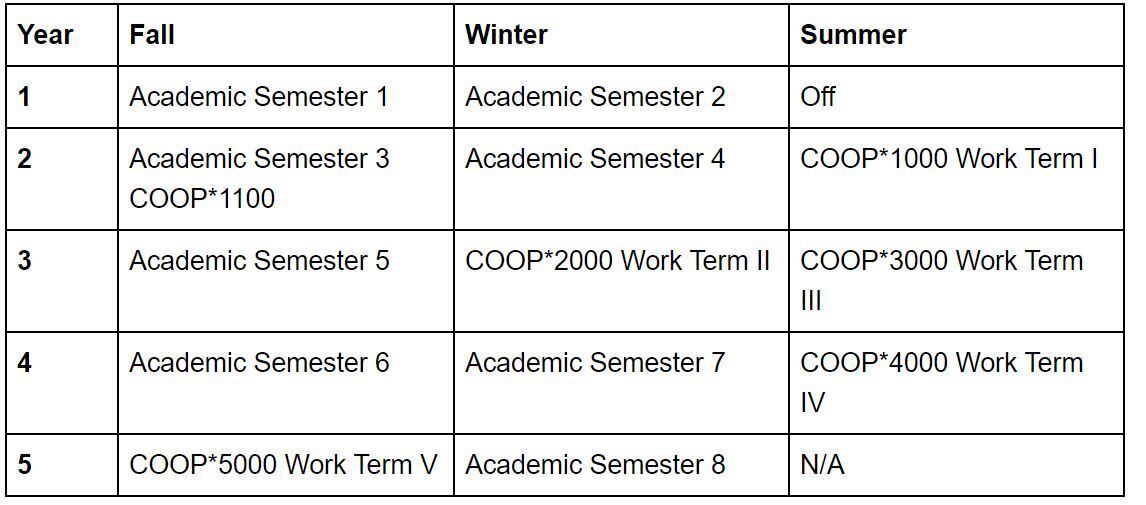
*Please note this sequence may change. The current undergraduate calendar will house the most accurate sequence that students must follow.
Students in this co-op major complete a course, COOP*1100, in the fall semester of second year. This course helps students prepare for their work term by developing professional attitudes and skills for the workplace. This course also provides students with a toolkit of resume and cover letter writing as well as interview skills, which helps students to apply, interview and secure their work term positions..
60 month
Duration
$ 30238
Tuition
Computer Science & IT
Bachelor of Computing in Software Engineering
Computers play many roles in our lives. At the School of Computer Science, we recognize that relationship and its variable nature. If you enjoy solving problems, nothing is more exciting than working and studying at the leading edge of computer science. You will develop skills throughout your degree as you explore different course materials within the field of computer science and across other disciplines. The program provides you with a strong foundation in hardware and theory with a particular focus on applied software development. By the time you graduate you will be a sought-after expert with interdisciplinary knowledge and skills that will make you indispensable.
Software Engineering
Contribute to innovative and cutting-edge software design. Providing a foundation in computer science concepts, this program focuses on team-based software development and professional standards. This major provides an excellent background in design and development, as well as the implementation and the evolution of software. Students’ soft skills such as communication and teamwork will be enhanced and strengthened. You will have a unique opportunity to take courses on different aspects of software engineering, including design methods, team interactions, communications and managing real-world software engineering projects.
48 month
Duration
$ 34147
Tuition
Computer Science & IT
Bachelor of Computing in Software Engineering (Co-op)
Computers play many roles in our lives. At the School of Computer Science, we recognize that relationship and its variable nature. If you enjoy solving problems, nothing is more exciting than working and studying at the leading edge of computer science. You will develop skills throughout your degree as you explore different course materials within the field of computer science and across other disciplines. The program provides you with a strong foundation in hardware and theory with a particular focus on applied software development. By the time you graduate you will be a sought-after expert with interdisciplinary knowledge and skills that will make you indispensable.
Software Engineering
Contribute to innovative and cutting-edge software design. Providing a foundation in computer science concepts, this program focuses on team-based software development and professional standards. This major provides an excellent background in design and development, as well as the implementation and the evolution of software. Students’ soft skills such as communication and teamwork will be enhanced and strengthened. You will have a unique opportunity to take courses on different aspects of software engineering, including design methods, team interactions, communications and managing real-world software engineering projects.
Co-op Option
The Co-op program in Software Engineering is a five year program, including five work terms. Students must complete a Fall, Winter and Summer work term and must follow the academic work schedule as outlined below.
| Year | Fall | Winter | Summer |
| 1 | Academic Semester 1 | Academic Semester 2 | Off |
| 2 | Academic Semester 3 COOP*1100 | Academic Semester 4 | COOP*1000 Work Term I |
| 3 | COOP*2000 Work Term II | Academic Semester 5 | COOP*3000 Work Term III |
| 4 | Academic Semester 6 | COOP*4000 Work Term IV | COOP*5000 Work Term V |
| 5 | Academic Semester 7 | Academic Semester 8 | N/A |
To be eligible to continue in the Co-op program, students must meet a minimum 70% cumulative average requirement after second semester, as well as meet all work term requirements. Please refer to the Co-operative Education program policy with respect to work term performance grading, work term report grading and program completion requirements.
60 month
Duration
$ 34147
Tuition
Arts & Humanities
Bachelor of Arts (Honours) in Mathematical Economics (Co-op)
Develop your aptitude for mathematics by considering its application to economic problems. Mathematics is an invaluable element of economic analysis to open up large areas of inquiry. These areas include problems involving consumer behaviour, the interactions among producers as they compete for market share, macroeconomic outcomes such as inflation and unemployment, and international trade and competitiveness. Courses in mathematics, statistics, economics and econometrics will sharpen your analytical skills for a career in industry, government or graduate work, and will provide a solid understanding of social policy issues and government actions.
WHY CO-OP?
As a co-op student, you will gain relevant work experience, build professional networks and develop essential interpersonal skills needed to succeed in the workplace, all while getting paid and earning your university degree. Guelph’s co-op program is unique due to the exceptional level of support provided, including an inclass preparatory course, a personal connection with a Co-op Coordinator to assist you during the employment process, and access to senior student mentors.
48 month
Duration
$ 30232
Tuition
Environmental Studies & Earth Sciences
Bachelor of Indigenous Environmental Science and Practice (Co-op)
The Bachelor of Indigenous Environmental Science and Practice (BIESP) is an interdisciplinary science degree that focuses on the development of leaders in areas of environmental science, land-use and policy development who are grounded in Indigenous ways of knowing and being. This science degree emphasizes the respectful and consensual braiding of Indigenous and Western knowledge systems to address complex environmental issues and challenges. It focuses on the responsible use and protection of the natural environment through practices based on Indigenous ways of knowing and doing and the practice of Indigenous land ethics grounded in Indigenous epistemologies, ontologies, traditions and aspirations. By explicitly recognizing the inherent validity and value of Indigenous ways of knowing and doing, this interdisciplinary program offers a critical, yet constructive, view of environmental science, grounded in Indigenous knowledge systems, methodologies, priorities and values and oriented towards concrete action. In addition to their studies of natural and applied science, students will examine the historical and contemporary relationships between Indigenous and non-Indigenous peoples in Canada and the legal, political and economic context of environmental science and practice.
Experiential learning is incorporated into each year of study through opportunities to interact and work directly with Indigenous communities and organizations supporting cross-cultural learning and practice. In the final year, students will conduct a group project that focuses on a current environmental issue and provides the opportunity to obtain realistic experiences within the interdisciplinary context of practicing environmental science with Indigenous communities. The BIESP is also offered as a co-op option.
Learning Outcomes
Graduates of the BIESP degree will have demonstrated they can:
- Build awareness of Indigenous cultural frameworks of environmental science including the role of traditional knowledge keepers, right relations, multi-generational environmental stewardship, and inclusion of non-human beings.
- Consider the implications of historical and contemporary relationships between Indigenous and non-Indigenous communities in influencing governance, practices, policies, interactions and decision making in environmental science and practice.
- Apply a critical and decolonial lens to the existing approach to environmental science and practice in Canada through the exploration of Indigenous principles, aspirations and practices while cognizant of the historical and ongoing legacy of colonization, land dispossession, and intergenerational trauma.
- Apply the evolving legal frameworks of Indigenous and non-Indigenous environmental science, which include Indigenous People’s inherent, treaty and constitutionally-protected rights, historic and contemporary lands, the minimal standard of free, prior, and informed consent, duty to consult and Indigenous-led practices of protection and restoration of special places and community well-being, to environmental stewardship.
- Bridge and braid Indigenous and Western knowledge systems to propose and evaluate answers and solutions to environmental questions.
- Formulate relevant and testable research questions, develop and implement an effective method of inquiry and perform appropriate quantitative and qualitative analyses for use in evidence-based environmental planning, policy development and implementation across different knowledge systems from Indigenous and Western research paradigms and methodologies.
- Utilize techniques and skills including mapping and GIS, data classification, spatial analysis, map design, Indigenous research methodologies and environmental risk assessment practices to analyze environmental management issues across different knowledge systems.
- Demonstrate project management skills (leadership, negotiation, communication, problem-solving, decision-making, time and task management, and budgeting) to effectively work within a team to complete multifaceted projects related to environmental management, research, and community engagement.
- Communicate ideas, arguments and analyses to Indigenous and non-Indigenous audiences accurately and effectively, recognizing the role of language, personal values, strengths and limitations, and respecting diverse perspectives.
- Demonstrate moral maturity and intercultural competency by considering diverse perspectives on environmental issues and Indigenous world views when acting as a professional and community member in decision making processes related to topics of land use, conservation, sustainability and environmental remediation and restoration.
- Critically reflect on their personal values, academic and professional goals and determine how they can continue to respectfully engage and sustain relationships with Indigenous and non-Indigenous communities to address environmental challenges utilizing both Indigenous and Western scientific knowledge systems and ethical protocols.
- Appreciate and support the needs and priorities of Indigenous communities to promote respect, protect and sustain Indigenous knowledge and practice in Indigenous communities.
Co-op
The Co-op program in Indigenous Environmental Science and Practice is a five-year program including four work terms. Students must follow the academic work schedule as outlined below (also found on the Co-operative Education website: https://www.recruitguelph.ca/cecs/).
Indigenous Environmental Science and Practice Academic and Co-op Work Term Schedule
| Year | Fall | Winter | Summer |
| 1 | Academic Semester 1 | Academic Semester 2 | Off |
| 2 | Academic Semester 3, COOP*1100 | Academic Semester 4 | COOP*1000 Work Term I |
| 3 | Academic Semester 5 | Academic Semester 6 | COOP*2000 Work Term II |
| 4 | OOP*3000 Work Term III | OP*4000 Work Term IV | Off |
| 5 | Academic Semester 7 | Academic Semester 8 | N/A |
60 month
Duration
$ 30290
Tuition
Engineering & Technology
Bachelor of Engineering in Water Resources Engineering
Water Resources Engineering focuses on the use and management of land and water resources in rural and urban watersheds.
A growing population and the need for clean water demands Water Resources Engineers to develop solutions that are environmentally sustainable and economically viable. Water Resources Engineering combines elements of other disciplines such as civil engineering, environmental engineering, agriculture, planning and geography in a unique combination ideally suited to address society's concerns and needs surrounding water.
Students design and develop creative solutions to protect groundwater, soil, wetlands, streams and lakes to ensure that the development of new water supplies not disrupt natural processes. Students learn to apply engineering analysis and computer models to identify water resources problems and design engineering solutions to these challenges.
48 month
Duration
$ 42264
Tuition
Natural Sciences & Mathematics
Bachelor of Arts (Major) in Statistics
Knowledge of statistics is crucial for understanding our world. An understanding of statistics is vital in many disciplines including psychology, sociology, political science, marketing and economics. Students can choose to study statistics as a minor in the B.A. Honours Program or as an area of concentration in the General Program.
36 month
Duration
$ 30232
Tuition
Agriculture, Forestry & Animal Sciences
Bachelor of Science in Plant Science (co-op optional)
Plant science is the study of the intricacies of plant diversity, growth and development, plant-environment interactions, advances in molecular biology, and the wide variety of economic uses for plants.
Explore the intricacies of plants through the study of their diversity, growth, development, environmental interactions, and various economic uses. Gain knowledge of advances in molecular biology, plant ecology, systematics, physiology, botany, genetics, agriculture, ethnobotany and biotechnology. Opportunities exist for hands-on experience in labs, field courses and individual research projects, and access to an active herbarium, special growth facilities and a renowned arboretum. Become a leader in the field of plant science and contribute to society's need for the efficient production of healthy foods and improved environmental management.
Learning Outcomes
You can expect to learn how to:
- Demonstrate knowledge in mechanisms related to the molecular, biochemical, physiological, organismal and ecological levels of plant organization from systems-based approaches
- Demonstrate knowledge in the fundamental vegetative, reproductive and genetic attributes of plants
- Demonstrate knowledge in the ecological interaction of plants with biotic and abiotic factors in natural and agricultural systems
- Demonstrate knowledge in plant diversity and genetic variability and their relationship to evolution, speciation and adaptation
- Demonstrate knowledge in the role of plants and their improvement to impact global, cultural and societal issues
48 month
Duration
$ 30290
Tuition
Arts & Humanities
Bachelor of Arts (Honours) in Creative Writing
Explore the ways writing can drive social justice and environmental awareness. Create meaning through your writing and storytelling. You will take courses in speculative fiction, non-fiction, poetry, screenwriting and writing for the inclusive stage. You will develop a body of creative work that includes writing exercises, short creative pieces and a portfolio.
48 month
Duration
$ 30232
Tuition
View All Courses by University of Guelph, Canada
Top Study Abroad Exams
Popular Universities to Study Abroad
- University of Waterloo
Waterloo
- University Canada West
Vancouver
- University of Windsor
Windsor
- Cape Breton University
Sydney
- Dalhusie University
Halifax
- Carleton University
Ottawa
- University of Ottawa
Ottawa
- University of Guelph
Guelph
- Explore more colleges in Canada
- University of New Haven
West Haven
- Kent State University
Kent
- Wright State University
Dayon
- San Jose State University
West Haven
- Clark University
Worcester
- Rowan University
Glassboro
- Golden Gate University
San Francisco
- Arkansas
San Francisco
- Explore more colleges in USA
- Coventry University
Coventry
- University of Birminghame
Birminghame
- De Montfort University
Leicester
- Cardiff University
Cardiff
- BPP University
London
- University of West London
London
- University of Nottingham
Nottingham
- University of Warwick
Coventry
- Explore more colleges in UK
- Auckland Institute Of Studies
Auckland
- Massey University - Auckland Campus
Albany
- Eastern Institute of Technology - Auckland Campus
Auckland
- NorthTec - Auckland Campus
Auckland
- Massey University - Manawatu Campus
Palmerston North
- University of West London
London
- Wellington Institute of Technology (WelTec) - Petone Campus
Lower Hutt
- Otago Polytechnic - Dunedin Campus
Dunedin
- Explore more colleges in New Zealand
- Chandigarh University
Mohali
- Parul University
Vadodara
- Sharda University
Greater Noida
- Jain University
Bangalore
- Bennett University
Greater Noida
- Lovely Professional University
Phagwara
- Chitkara University
Rajpura
- Brainware University
Kolkata
- Explore more colleges in India
- Abu Dhabi University
Abu Dhabi
- Gulf Medical University
Ajman
- New York University
Abu Dhabi
- Emirates Aviation University
Dubai
- Higher Colleges of Technology
Dubai
- British University in Dubai
Dubai
- Al Ghurair University
Dubai
- American University in the Emirates
Dubai
- Rochester Institute Of Technology Dubai
Dubai
- Emirates Academy of Hospitality Management
Dubai
- American University of Ras Al Khaimah
Ras Al Khaimah
- Explore more colleges in UAE
- Ras Al Khaimah Medical and Health Sciences University
Ras Al Khaimah
Explore Colleges and Courses in Canada
- Arts & Humanities in canada
- Business & Management in canada
- Natural Sciences & Mathematics in canada
- Engineering & Technology in canada
- Computer Science & IT in canada
- Health Sciences, Nursing and Emergency Services in canada
- Social Sciences in canada
- Creative Arts & Design in canada
- Hospitality, Tourism, Wellness Leisure & Sports in canada
- Environmental Studies & Earth Sciences in canada
Latest Blog Posts


Canada
2024-01-18 06:13:32
1660 Views
MIM in Canada Without GMAT: Best Colleges for MIM Without GMAT in Canada
Canada
2024-01-03 07:27:42
1461 Views
Top 10 universities in Canada 2024 by Times Higher Education (THE) World University Rankings
Canada
2023-10-13 10:24:49
1631 Views
MBBS in Canada: Program Duration, Cost, Top Universities, Eligibility, Scholarship
Trending Blog Posts


Tips and tricks
2022-08-19 04:34:00
457300 Views
CGPA Calculator - How to Convert CGPA to Percentage?

USA
2022-07-29 05:32:00
143582 Views
Spring Intake in USA 2024: Deadline & Universities

Exam
2023-01-03 11:30:18
195115 Views
IELTS Speaking Cue Cards Topics & Samples with Answers 2024

Search, Shortlist, Apply and get accepted! It’s that Simple to pursue your dream to Study abroad with Edmissions. Our team of experts provide you the right guidance that helps you to take admission in your dream college in countries like Canada, the USA, the UK
© 2021-2024 Edmissions - All rights reserved.


TALK TO OUR EXPERTS